
Electricity & Bills
Why Is My Electric Bill So High?
A step-by-step way to find what's really driving your bill, from heating and cooling to always-on devices.
3 min read
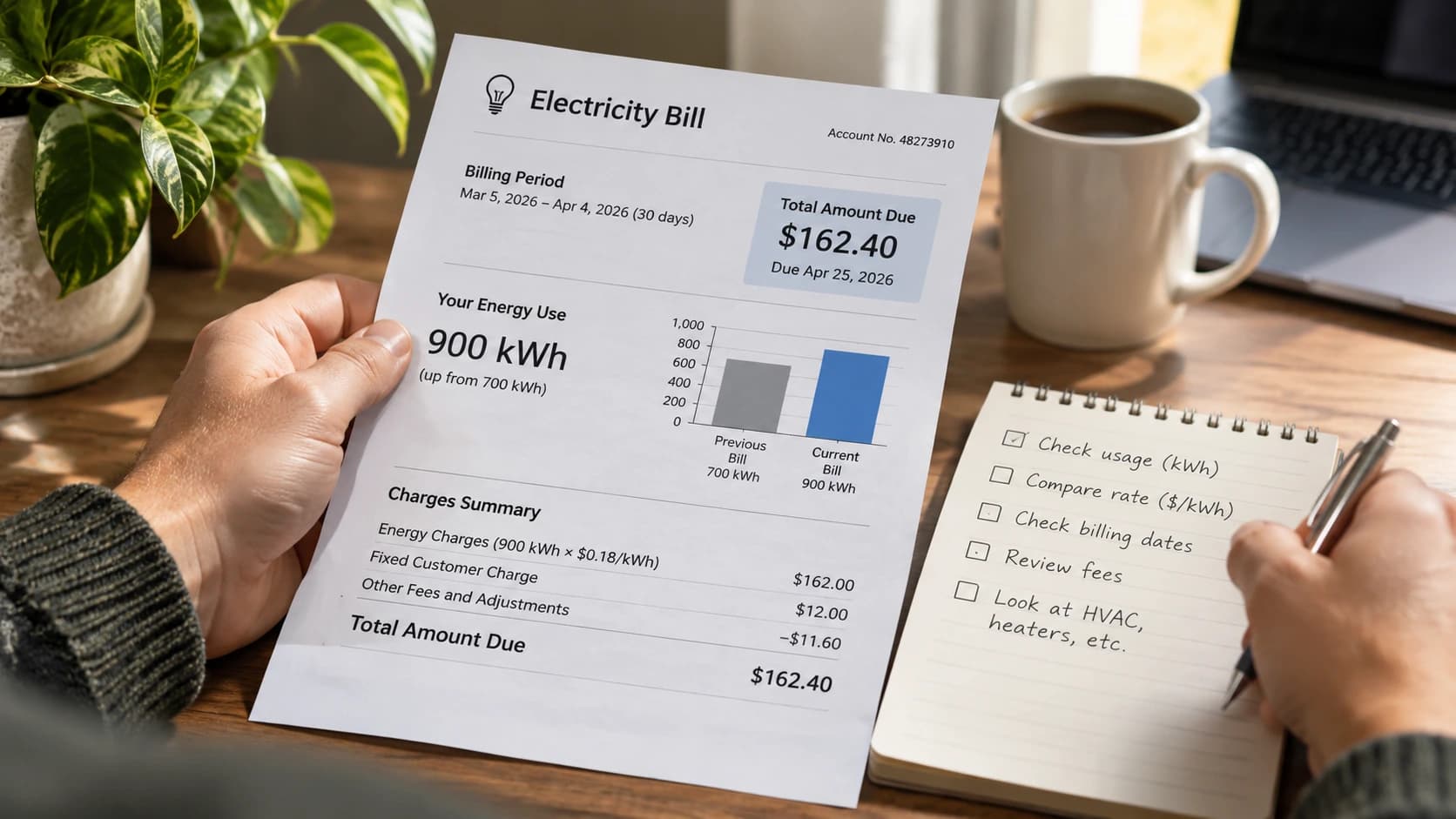
A higher electric bill doesn't always mean your household used more electricity. The total can rise because you consumed more kWh, the price per kWh increased, the billing period was longer, or new fees and adjustments appeared. You can usually narrow down the reason by comparing two bills before changing anything in your home.
First, separate usage from price
Find four items on your current and previous statements: billing dates, total kWh, variable energy charges, and fixed fees or other adjustments. Write them side by side.
| Example bill component | Previous bill | Current bill |
|---|---|---|
| Electricity used | 700 kWh | 900 kWh |
| Example variable rate | $0.16/kWh | $0.18/kWh |
| Energy charges | $112 | $162 |
The example energy charge rose by $50. To avoid mixing the effects of price and usage, decompose that $50 increase: the extra 200 kWh at the old $0.16 rate adds $32; applying the extra $0.02 to all 900 current kWh adds another $18. Combined, $50. This comparison excludes fixed charges. Both usage and rate changes matter.
Divide kWh by billed days to estimate average daily consumption. A 33-day bill can be higher than a 28-day bill even when your everyday routine barely changes.
Next, check heating and cooling
Air conditioning and electric heating can drive large seasonal changes. Compare the dates of your bill with hot or cold weather, thermostat settings and hours spent at home. A heat pump may draw more electricity during cold weather, particularly if auxiliary resistance heating is activated. Portable heaters can also add noticeable kWh.
An illustrative 1,500-watt heater running four full-power hours daily for 30 days uses 180 kWh. At $0.18/kWh, that adds $32.40 in energy charges. If it cycles, actual use can be lower. See the space heater cost breakdown or estimate AC operating costs.
Check hot water, laundry and appliances
If your water heater is electric, longer showers, a malfunctioning hot-water component or a temperature-setting change can affect electricity usage. Electric clothes dryers, dehumidifiers and pumps can also be significant depending on run time. Refrigerators generally run year-round, but a failing door seal or unusually frequent compressor operation can raise consumption.
Look for changes rather than guessing which appliance is "worst." A new home-office setup, extra household member, pool pump schedule or basement dehumidifier can change your usage even if no single new purchase seems dramatic.
Investigate loads that never turn off
Routers, servers, entertainment gear and other devices can draw power around the clock. For example, a device averaging 20 watts for 24 hours daily uses 14.4 kWh over 30 days: $2.59 at $0.18/kWh. That is worth understanding, though it is unlikely to explain a sudden $100 increase by itself. Prioritize large and newly changed loads before chasing tiny standby savings.
Use a suitable plug-in meter for individual appliances. For hardwired equipment, review its documentation or consult a qualified professional. Never remove an electrical panel cover to investigate household consumption.
What if the usage appears wrong?
Compare the meter reading shown on the bill with your actual meter if it is safe and accessible, and check for estimated readings. Verify that your utility billed the correct meter and service address. Sudden unexplained use may justify asking the utility about a meter check or a billing review. If a breaker trips repeatedly, outlets become hot or you suspect an electrical fault, contact a licensed electrician rather than experimenting.
Build a short diagnostic plan
Start with the bill comparison, then identify the two or three loads most likely to have changed. Estimate their additional kWh: watts ÷ 1,000 × extra operating hours. Multiply by the variable electricity rate. If those estimates explain most of the increase, you have a useful starting hypothesis. If not, investigate rates, estimated meter readings and other equipment.
Use the Electricity Cost Calculator to test suspected loads, and read how to calculate an appliance's running cost for the underlying formula.
A bill is a record of charges, not a diagnosis. The best fix follows the evidence: which number changed, when it changed, and which household loads plausibly explain it.
Sources and further reading
More on electricity & bills
Electricity & Bills
How Much Does It Cost to Run an Appliance?
Watts to kWh to dollars: the one formula behind every appliance's running cost, with worked examples.
4 min read