
Backup Power & Outages
How Long Will a Router, Boiler, and Refrigerator Run on a Power Station?
A worked example with battery losses, appliance cycling and startup power — for 1,024 Wh and 2,048 Wh stations.
5 min read
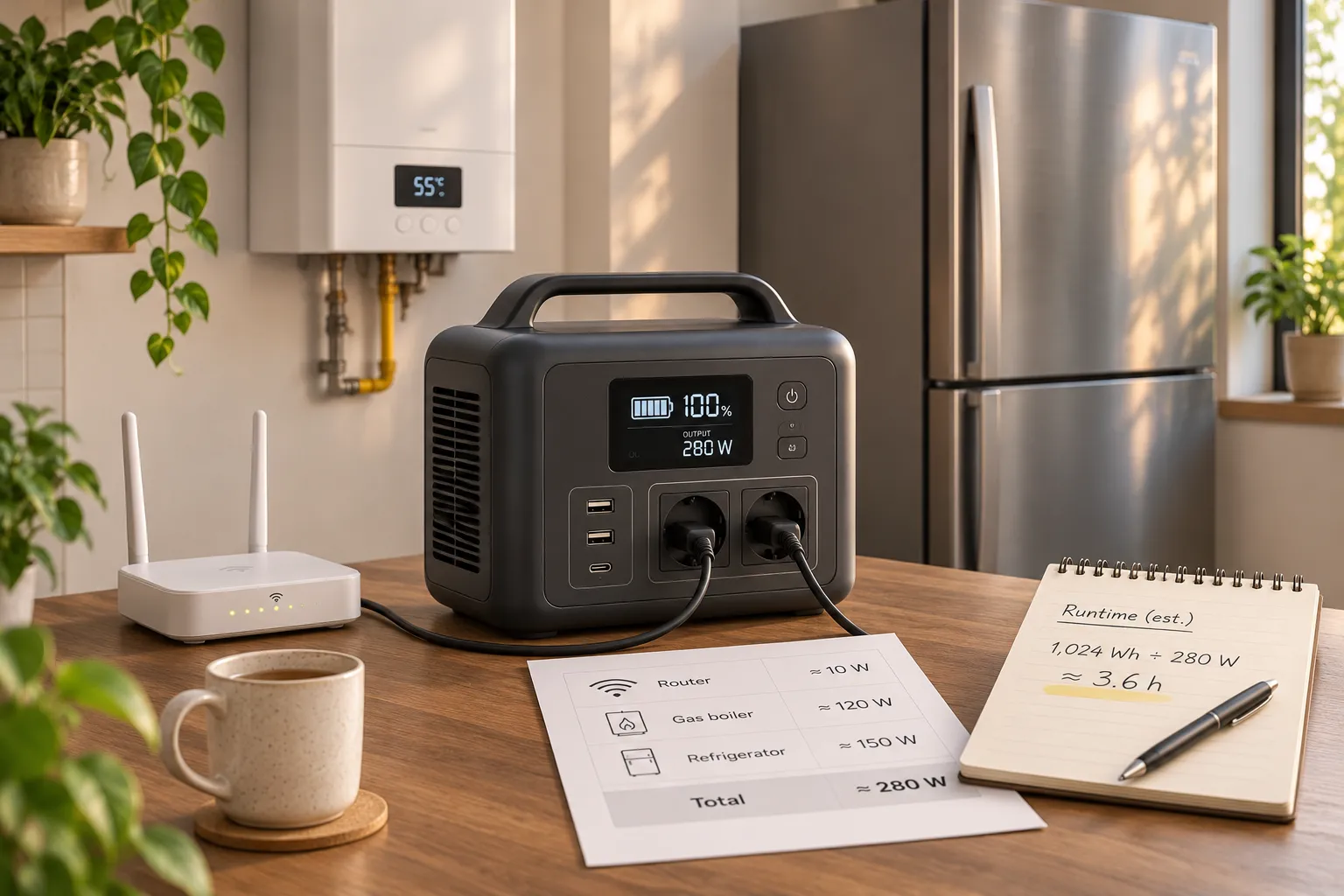
Keeping the internet on during an outage is relatively straightforward. Keeping the internet, heating system, and refrigerator running together takes more planning.
These appliances behave differently. A router draws a fairly steady amount of power, while a refrigerator cycles its compressor on and off. A gas boiler may also switch its pump, fan, and controls between operating states. That makes battery capacity alone a poor way to predict runtime.
To estimate how long a portable power station will last, you need the average power consumption of each device, the battery's usable energy, and confirmation that the station can handle startup loads.
How much electricity do these devices use?
The following figures are illustrative assumptions for a household backup scenario. They are not specifications for every router, boiler, or refrigerator.
| Device | Power while operating | Assumed operating pattern | Average power |
|---|---|---|---|
| Wi-Fi router | 12 W | Always on | 12 W |
| ONU terminal | 8 W | Always on | 8 W |
| Gas boiler electrical components | 80 W | Active 50% of the time | 40 W |
| Refrigerator compressor | 120 W | Active 35% of the time | 42 W |
| Total | 102 W |
Under these assumptions, the average combined electrical load is 102 W.
The boiler's 80 W represents electricity used by equipment such as the circulation pump, fan, and controls. It does not represent the boiler's gas heating output. Similarly, a refrigerator consuming 120 W while its compressor operates is not necessarily drawing 120 W continuously throughout the day.
Actual duty cycles depend on room temperature, appliance design, thermostat settings, and operating conditions.
Example: a 1,024 Wh power station
Suppose your power station has a rated battery capacity of 1,024 Wh. We'll use two planning assumptions:
- Overall energy delivery efficiency: 85%
- Battery reserve: 10% of rated capacity
The estimated energy available for appliances is:
1,024 Wh × 0.85 × 0.90 = 783 Wh
Now divide that usable energy by the estimated average load:
783 Wh ÷ 102 W = 7.7 hours
Under these assumptions, the station could run the selected devices for approximately seven to eight hours.
This is a planning estimate, not a guaranteed runtime. A real power station may perform differently because of inverter standby consumption, battery temperature, state of charge, losses at different load levels, and appliance cycling. If the refrigerator or boiler operates more frequently than assumed, runtime will be shorter.
What changes with a larger battery?
Consider the same equipment connected to a 2,048 Wh station. Using the same efficiency and reserve assumptions:
2,048 Wh × 0.85 × 0.90 = 1,567 Wh
1,567 Wh ÷ 102 W = 15.4 hours
Doubling the battery capacity approximately doubles the estimated runtime, provided the load remains comparable. However, capacity alone does not tell you whether the station can start the refrigerator or supply the boiler correctly. Those requirements need to be checked separately.
Router and ONU: small loads that run continuously
A home internet connection may involve more than one device. In many fiber installations, an ONU or ONT converts the optical signal, while a separate Wi-Fi router provides the local network. Both devices may need power during an outage.
In our example:
12 W + 8 W = 20 W
Over eight hours:
20 W × 8 hours = 160 Wh
That is a relatively small energy requirement compared with heating appliances.
For some setups, a dedicated DC backup device or compatible mini UPS may be more efficient than running a large AC inverter continuously. But first check the voltage, current, connector polarity, and power requirements of your actual networking equipment.
Backup power also does not guarantee that your internet provider's upstream equipment will remain operational during an outage.
Gas boiler: electricity is only part of the requirement
A gas boiler uses fuel to produce heat, but many modern models also depend on electricity. Electrical components may include the circulation pump, ignition system, combustion fan, display, and control electronics.
Their power consumption varies significantly between models and operating states. For accurate planning, use the boiler's technical documentation or a suitable meter, rather than assuming every boiler consumes the same amount of electricity.
The power station must also provide an electrically compatible output. Some boiler systems are sensitive to grounding arrangements, neutral connections, or power quality.
Never improvise wiring or grounding connections to make a boiler operate from a backup source. Consult the equipment manufacturer or a qualified electrician if compatibility is uncertain.
And remember: a power station can keep the electrical components supplied, but it cannot replace the gas or other fuel required by the heating system.
Refrigerator: average use is not startup power
Refrigerators are among the most difficult household appliances to estimate from nameplate wattage alone. The compressor cycles on and off. Defrost heaters, fans, and electronic controls may add intermittent loads.
For this reason, daily energy consumption is often more useful than a single operating wattage. If a refrigerator consumes 420 kWh per year under its labeled test conditions, its average daily energy consumption is:
420 ÷ 365 = 1.15 kWh per day
That corresponds to an average power of approximately:
1,150 Wh ÷ 24 hours = 48 W
But that does not mean the refrigerator continuously draws 48 W. It may use much more electricity when the compressor starts or runs, then much less between cycles.
The US Department of Energy recommends measuring an existing refrigerator over several days when planning backup refrigeration. It also notes that compressor startup demand can be significantly higher than running demand. A battery with sufficient stored energy may still be unable to start the compressor if its surge output is inadequate.
How to improve your runtime estimate
Start with the actual appliances. Read the labels and specifications, then measure their consumption where practical. A plug-in electricity meter can be useful for compatible cord-connected equipment.
For the refrigerator, longer measurement periods are better because they capture compressor cycles and defrost operation. For a boiler, check its electrical operating requirements and use qualified help where needed.
Also consider which devices really need continuous power. Reducing the load from unnecessary lighting, monitors, or other electronics can preserve energy for essential equipment.
Finally, avoid treating the displayed battery percentage as a precise prediction of remaining hours. It is an estimate produced by the station's battery-management system.
Check both runtime and compatibility
A 1,024 Wh station might provide around eight hours for our example household setup. A 2,048 Wh station might provide around fifteen hours. Those figures depend on the stated assumptions.
For a reliable backup plan, confirm three separate things:
- Enough usable battery energy for the expected outage.
- Enough continuous and surge output for connected appliances.
- Correct electrical compatibility with each device.
Calculate your setup
Enter your battery capacity, inverter efficiency, and appliance loads in the Power Station Runtime Calculator. For a larger backup system, use the Backup Power Planner to compare your essential loads and estimate the capacity needed for different outage durations.
Sources and further reading
More on backup power & outages
Backup Power & Outages
How to Choose a Portable Power Station for an Apartment
Battery capacity, continuous output, surge power and charging speed: what to check before you buy.
6 min read
Backup Power & Outages
How Much Does It Cost to Run a Generator per Hour?
Fuel cost per hour, cost per kWh and why generator load matters — with gallon and liter examples.
6 min read