
Backup Power & Outages
How to Choose a Portable Power Station for an Apartment
Battery capacity, continuous output, surge power and charging speed: what to check before you buy.
6 min read
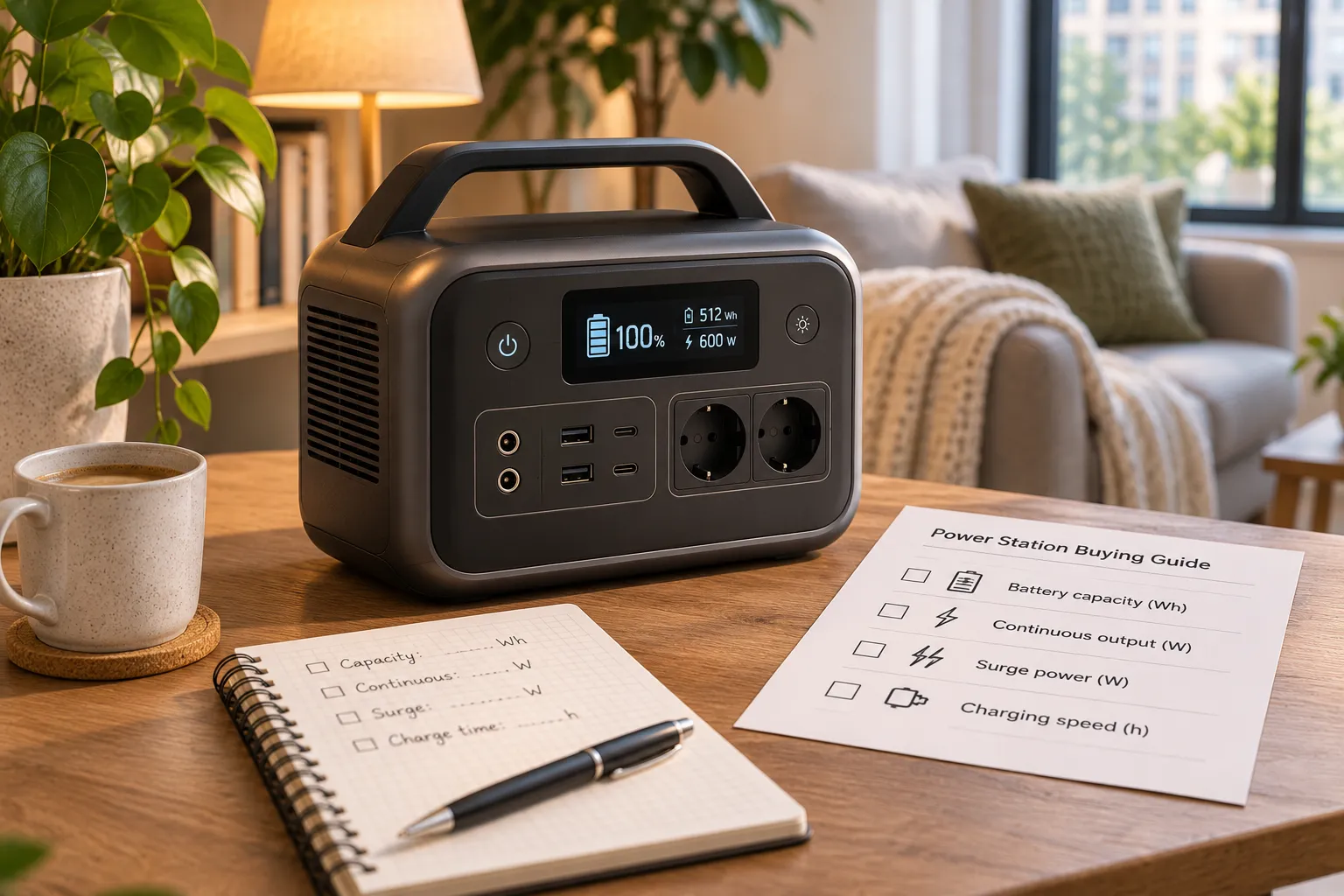
A portable power station can keep your internet connection, lighting, laptop, and selected household appliances running during a power outage. But choosing one based on battery size alone can lead to an expensive mistake.
A station may store enough energy for several hours but lack the output power to start your refrigerator. Another may have a powerful inverter yet run out of battery much sooner than expected.
Before comparing models, it helps to understand three specifications: battery capacity, continuous output, and surge power.
Start with the devices you need
Don't begin with the largest power station you can afford. Start with the appliances that matter during an outage.
For an apartment, that might include a Wi-Fi router, an optical network terminal (ONU), a laptop, LED lighting, and phone chargers. A refrigerator or gas boiler may also be a priority, but these devices introduce additional requirements.
Make a list of what you actually intend to run. Separate equipment that must stay on continuously from devices you can use occasionally.
For example, an electric kettle might draw more power for a few minutes than your router uses in an entire day. That doesn't necessarily make it a priority for backup power.
Once you know which devices you need, you can work out how much battery capacity and inverter power they require.
Battery capacity: what does Wh mean?
Power station capacity is usually specified in watt-hours (Wh). Watt-hours describe stored energy, not how powerful the station is.
A 1,000 Wh battery theoretically contains enough energy to supply:
- A 100 W load for 10 hours
- A 200 W load for 5 hours
- A 500 W load for 2 hours
Those are ideal calculations. In practice, some energy is lost during conversion, and the station itself consumes electricity. A simplified runtime formula is:
Runtime (hours) = Battery capacity (Wh) × usable efficiency ÷ average load (W)
For an initial estimate, you might assume 85% overall delivery efficiency. This is an illustrative planning assumption, not a specification that applies to every device. Real efficiency depends on the power station, output type, load, temperature, and operating conditions.
A 1,000 Wh station supplying a steady 100 W AC load would then have an estimated runtime of:
1,000 × 0.85 ÷ 100 = 8.5 hours
Actual results may differ, particularly at very low loads where inverter standby consumption can become significant.
Continuous output: what can the station power?
Battery capacity determines how long the station can operate. Continuous output determines how much power it can supply at once.
Consider two stations:
- Station A: 1,024 Wh capacity, 600 W continuous output
- Station B: 1,024 Wh capacity, 1,800 W continuous output
Both store approximately the same amount of energy. However, Station B can operate more demanding appliances.
If you connect a device that requires 1,500 W to a station rated for 600 W continuous output, the station may enter overload protection or refuse to power the appliance.
The important number is the combined power of everything running simultaneously. For a simple apartment backup setup, a router, laptop, and several LED lights may require relatively little output power. A refrigerator, microwave, heater, or kettle changes the calculation considerably.
Surge power: why refrigerators require extra attention
Some appliances briefly draw considerably more power when they start than when they are running normally. Refrigerators, pumps, and other motor-driven equipment are common examples.
A refrigerator that consumes 120 W while its compressor is running could require substantially more power during startup. The actual surge depends on the appliance.
A power station needs enough surge capability for that initial demand, even if the refrigerator's average electricity consumption is fairly low. Before buying a station for a motor-driven appliance, check:
- The appliance's running power
- Its startup or inrush requirements
- The station's continuous output rating
- The station's surge rating and supported surge duration
Manufacturer specifications are more useful here than generic appliance wattage charts.
How much capacity does an apartment need?
Let's calculate a basic eight-hour backup setup.
| Device | Assumed power |
|---|---|
| Wi-Fi router | 12 W |
| ONU terminal | 8 W |
| Laptop | 45 W |
| LED lighting | 20 W |
| Total | 85 W |
If all four loads operate continuously for eight hours:
85 W × 8 hours = 680 Wh
Assuming 85% delivery efficiency:
680 ÷ 0.85 = 800 Wh
If you also want to leave 10% of the battery's rated capacity unused as a reserve:
680 ÷ (0.85 × 0.90) = 889 Wh
A station around 1,000 Wh would therefore be a reasonable starting point for this example, provided its output ratings and connectors match the equipment. This does not include a refrigerator, heating equipment, or other significant loads.
Battery chemistry and lifespan
Two battery chemistries commonly found in portable stations are lithium iron phosphate (LFP or LiFePO4) and nickel manganese cobalt (NMC).
LFP models are often attractive for regularly used home backup because they can offer a long cycle life. NMC-based designs may provide different advantages in energy density and weight. Battery chemistry alone does not determine product quality.
Compare the manufacturer's stated cycle life, warranty, usable capacity, operating temperature range, and safety documentation. Also check what the cycle-life specification actually means: a manufacturer may define it as the number of cycles before the battery retains a particular percentage of its original capacity.
Pure sine wave and equipment compatibility
If you plan to power household appliances through AC outlets, look for a power station with a pure sine wave inverter. Some electrical equipment, including certain motors, pumps, and sensitive electronics, may not operate properly with modified sine wave output.
The station must also provide the correct voltage and frequency for your appliances. Equipment intended for a Ukrainian household will generally require a compatible 230 V, 50 Hz supply, while many US appliances are designed for 120 V, 60 Hz operation.
For gas boilers, correct voltage and a pure sine wave are not always enough. Some systems have specific grounding, neutral, or electrical protection requirements. Verify compatibility with the boiler manufacturer and consult a qualified electrician when necessary.
Charging speed matters, too
Capacity tells you how much energy the station stores. Charging power helps determine how quickly you can replenish it.
A station with 1,000 Wh of capacity and 500 W charging input has an ideal minimum charging time of approximately two hours from empty. Real charging takes longer because of conversion losses, charging limits, and the way charging power may decrease as the battery approaches full capacity.
If power returns only for short periods, recharge speed can be just as important as battery size. Check whether the station supports charging from a wall outlet, compatible solar panels, or other sources you intend to use.
What about UPS functionality?
Some power stations support pass-through operation or an EPS/UPS-style backup mode. That does not necessarily make them equivalent to a dedicated uninterruptible power supply.
The switching time matters. A brief interruption might be acceptable for some devices but cause a router or computer to restart. If uninterrupted operation is essential, check the manufacturer's documented transfer time and compatibility with the connected equipment.
Before buying
The best station for an apartment is not necessarily the largest model. A practical choice should have enough usable battery capacity for your planned outage, enough continuous and surge output for your appliances, suitable electrical connections, and a charging system that matches your circumstances.
Pay attention to noise, weight, dimensions, warranty, and the manufacturer's safety instructions as well.
A portable power station can be used indoors according to its instructions, unlike a fuel-powered generator, but it still contains a high-energy battery. Use approved charging equipment, maintain ventilation clearance, and avoid damaged or recalled products.
Most importantly, calculate your actual loads before choosing a model.
Calculate your own backup runtime
Use the Power Station Runtime Calculator to estimate how long a battery can operate your devices after accounting for conversion losses. You can also use the Backup Power Planner to estimate the battery capacity and inverter output needed for a selected group of appliances.
Sources and further reading
More on backup power & outages
Backup Power & Outages
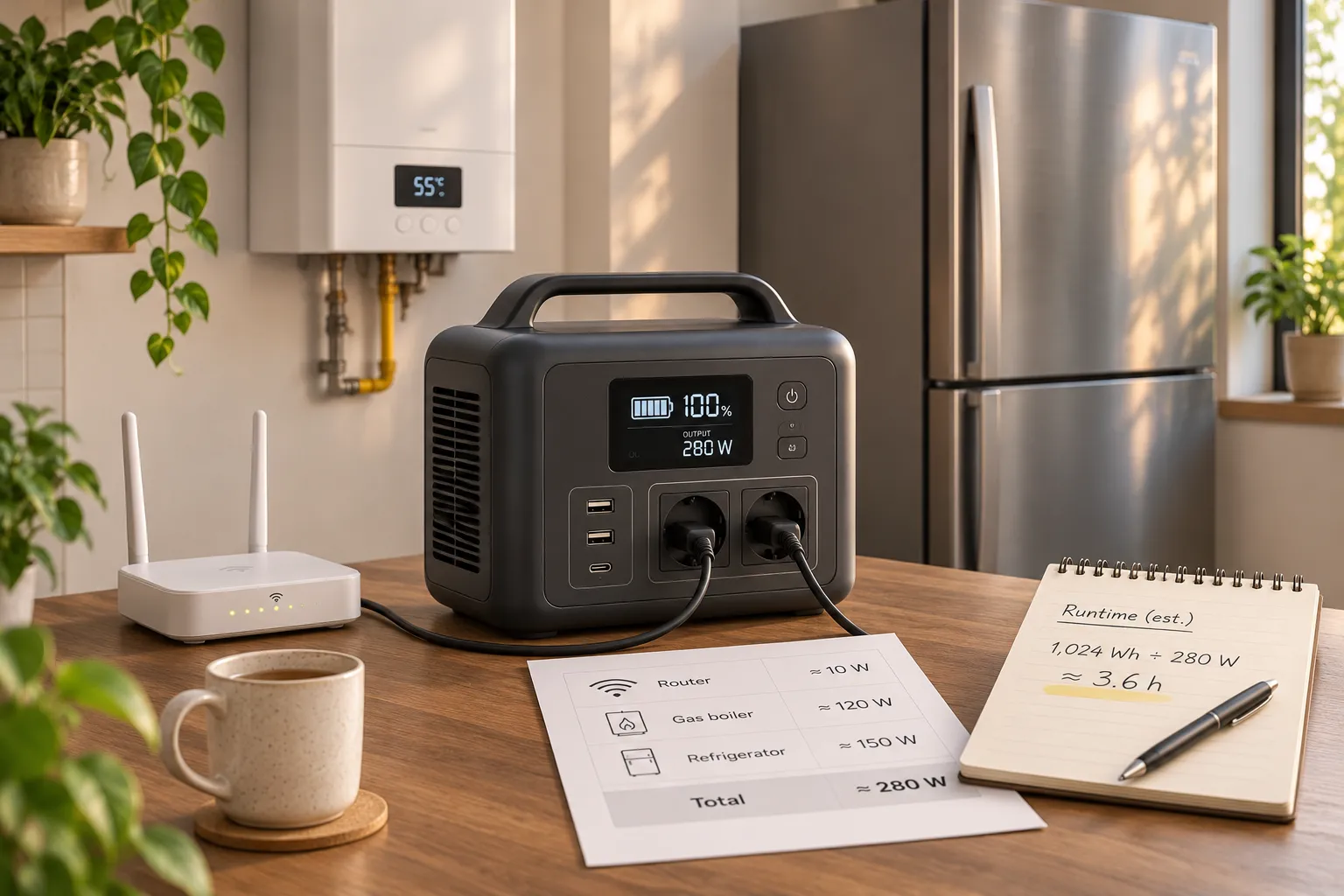
How Long Will a Router, Boiler, and Refrigerator Run on a Power Station?
A worked example with battery losses, appliance cycling and startup power — for 1,024 Wh and 2,048 Wh stations.
5 min read
Backup Power & Outages
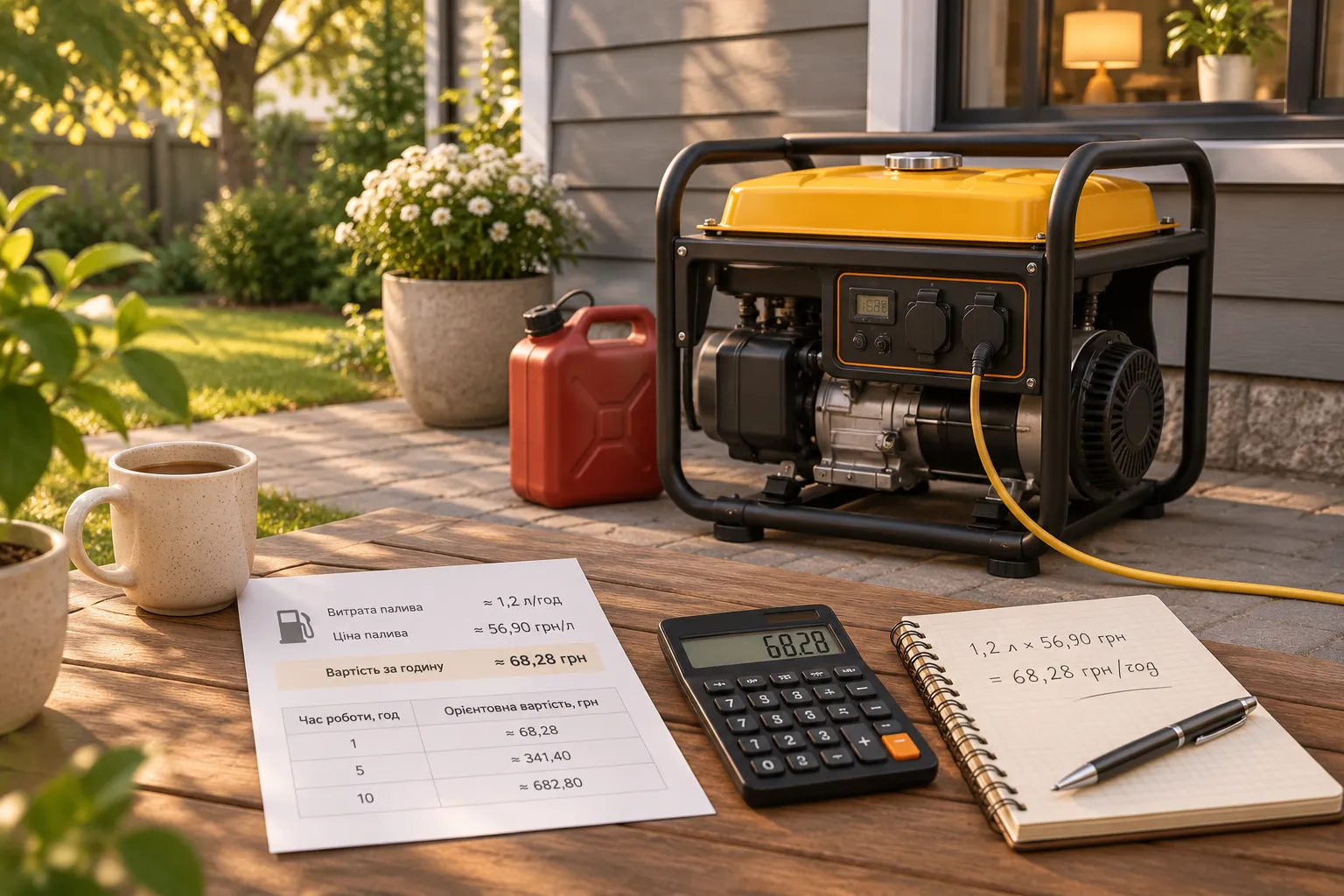
How Much Does It Cost to Run a Generator per Hour?
Fuel cost per hour, cost per kWh and why generator load matters — with gallon and liter examples.
6 min read