
Appliances & Electronics
How Much Electricity Does a Refrigerator Use?
Why a fridge's yearly kWh matters more than its wattage, and what newer and older models cost to run.
3 min read
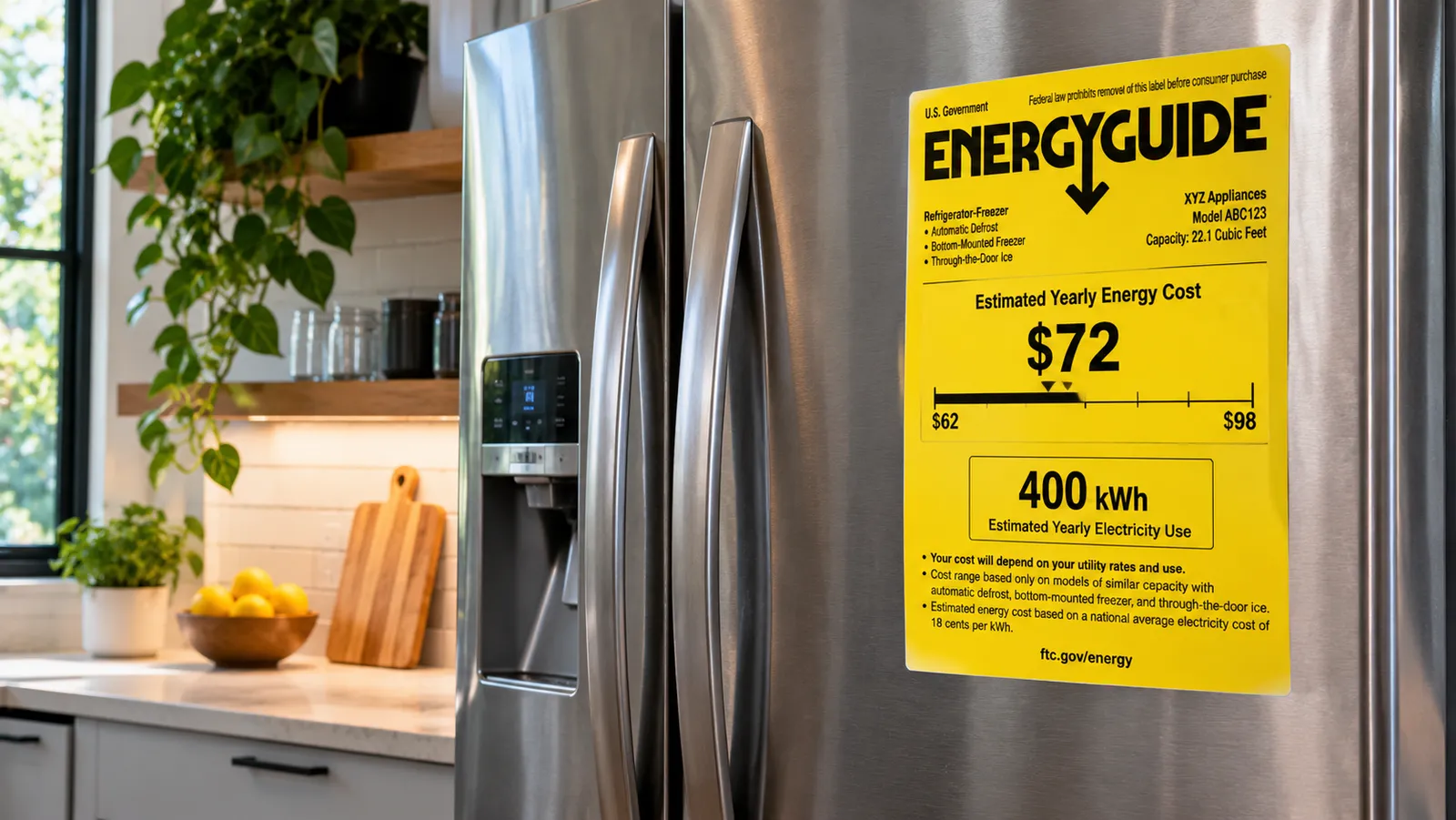
For a refrigerator, annual kilowatt-hours (kWh/year) is usually a more useful cost figure than the wattage printed on its rating plate. If a model uses 400 kWh per year, it costs about $72 per year for electricity at an illustrative $0.18/kWh. That's roughly $6 a month. A different model, larger capacity or different household conditions can change the result substantially.
Look for annual kWh on the EnergyGuide label
In the United States, many new refrigerators have a yellow EnergyGuide label that provides an estimated yearly electricity use or annual operating cost under standardized assumptions. Use the kWh/year figure to apply your own rate, because the dollar amount on the label may use a standardized energy price that differs from yours.
Annual electricity cost = annual kWh × electricity price per kWh.
A refrigerator labeled 450 kWh/year would cost 450 × $0.18 = $81 a year at the example rate. That works out to $6.75 per month when averaged across 12 months, not necessarily the precise cost of any specific month.
A transparent comparison
The following are illustrative consumption scenarios, not averages for refrigerator age groups:
| Measured or labeled use | Cost/year at $0.18/kWh | Average cost/month |
|---|---|---|
| 250 kWh/year | $45 | $3.75 |
| 400 kWh/year | $72 | $6.00 |
| 600 kWh/year | $108 | $9.00 |
| 900 kWh/year | $162 | $13.50 |
Notice that changing from a 900-kWh/year unit to a 400-kWh/year unit could reduce annual energy charges by $90 at the assumed rate. Whether replacement makes financial sense depends on the appliance's purchase price, condition and remaining service life, not merely the electricity difference.
Why the wattage label can mislead
A compressor cycles. During an active cooling cycle, electrical demand can be substantially higher than the refrigerator's average over a day. Defrost systems, ice makers and fans can add consumption. Multiplying a momentary or nameplate watt rating by 24 hours can overstate daily energy use.
For an existing refrigerator without an accessible EnergyGuide estimate, use a suitably rated plug-in meter to measure kWh for several days, ideally across a representative period. Calculate daily kWh = measured kWh ÷ measured days. Multiply by 365 for a simple annual projection, noting that kitchen temperatures and patterns vary by season.
What raises real-world consumption?
A door left ajar, worn gaskets, poor ventilation around the cabinet, heavy frost or malfunctioning components can increase electricity use. Frequent door openings and placing warm food inside also add a cooling load, though the effect depends on circumstances. Follow the manufacturer's guidance on clearances and temperature settings, and avoid blocking internal air passages.
Refrigerators vary by capacity, configuration, features and efficiency. A large side-by-side refrigerator with an ice dispenser cannot fairly be judged by the same annual consumption target as a small compact model.
Should you replace an older refrigerator?
Compare the measured consumption of the existing unit with the EnergyGuide kWh/year of a suitable replacement. Multiply the difference by your utility rate, then compare the yearly saving with the total replacement cost. If the old appliance is failing or needs expensive repairs, replacement may make sense for reasons beyond electricity savings.
The Refrigerator Electricity Cost Calculator lets you enter an annual kWh estimate or the parameters it supports. For the general math, see how to calculate any appliance's running cost. A refrigerator's cost is best understood over months and years, not from one instant of compressor power.
Sources and further reading
More on appliances & electronics
Appliances & Electronics
How Much Electricity Does a Gaming PC Use?
Gaming, idle and sleep power for real builds, plus monitors — and what that adds to your monthly bill.
3 min read
Appliances & Electronics
How Much Does It Cost to Run LED Lights?
LED vs. CFL vs. incandescent at the same brightness, and how quickly switching pays for itself.
3 min read